
Before the Enforcement Window: The H2 2026 Accountability Calendar Arrives | 06.16.26
- Aria Chen

- 5 hours ago
- 4 min read
Welcome to Tuesday, where regulatory enforcement is converting AI governance from aspirational commitment to operational obligation.
AI Governance TLDR; for 06.16.26:
The second half of 2026 is when the AI accountability calendar gets real. Colorado's AI Act takes effect June 30, the EU AI Act's broadest enforcement window opens in August, and Texas's RAIGA has been live since January — three frameworks that together shift accountability requirements from policy language to legal exposure. White & Case's continuously updated regulatory tracker puts the specificity in sharp focus: these laws require named ownership chains, documented oversight protocols, and the kind of runtime auditability that no compliance policy alone can provide. Academic survey work is simultaneously confirming the structural failure mode that practitioners already know: governance models designed for static AI systems break predictably when applied to autonomous, agentic deployments that act continuously and compose dynamically with other systems. The organizations shaping governance infrastructure today are setting the baseline that regulators will audit against tomorrow.
AI Governance News Roll-up:
The convergence of enforcement calendars in H2 2026 demands an architectural response, not just a compliance one. The EU AI Act's tiered penalty structure — up to €35M or 7% of global annual revenue — has moved accountability out of the legal department and into system design. That's a structural shift: organizations that treated governance as a post-deployment layer are discovering that accountability without auditability is liability with extra steps. The ISO/IEC 42001 management system standard is emerging as the documentation baseline regulators expect to see, but a management standard alone cannot substitute for governance embedded at the operational layer. The deeper challenge is one that academic research is now quantifying systematically: agentic AI systems introduce emergent behavior that evades governance models built for static deployments. The question every governance architect needs to answer is not whether a system has a policy — it's whether that governance holds when the system acts autonomously, at scale, in ways that weren't explicitly anticipated at design time. Singapore's Model AI Governance Framework for Agentic AI, launched in January 2026, is the clearest signal yet that regulators understand this distinction: agents that act rather than advise require fundamentally different governance approaches.
White & Case Tracker: The AI Accountability Calendar Every Governance Architect Needs
Type: Policy & Legal Analysis | Source: White & Case LLP
White & Case's living regulatory tracker makes explicit what the enforcement calendar already implied: AI accountability requirements are no longer aspirational — they carry deadlines, named compliance owners, and tiered legal exposure. The gap between a governance policy and a governance architecture has never had a clearer price.
BCS Insight:
Three landmark AI frameworks now carry enforcement teeth in 2026: Texas's RAIGA (effective January), Colorado's AI Act (June 30), and the EU AI Act's broadest enforcement window (August), with penalties reaching €35M or 7% of global annual revenue for the most serious violations. What this convergence demands architecturally is runtime auditability — the ability to demonstrate, at the moment of regulatory inquiry, that a system behaved within sanctioned boundaries and that accountability was embedded by design, not retrofitted under audit pressure. The California AI Transparency Act, effective January 1, adds a disclosure requirement at the output layer: accountability obligations are now reaching into the decision surface of AI systems, not just the deployment decision. The organizations that will navigate H2 2026 well are the ones that built accountability into system architecture at design time. What the White & Case tracker makes clear is that the window for treating this as a future-state problem has closed.
Academic Survey: Why Governance Frameworks Built for Static AI Break When Applied to Agentic Systems
Type: Academic Research | Source: arXiv
A comprehensive survey of AI governance frameworks identifies a consistent failure pattern — not in policy intent, but in architectural implementation. Governance models designed for static AI systems break predictably when applied to agentic, distributed deployments that act continuously, adapt, and compose with other systems in ways that were never explicitly authorized.
BCS Insight:
The survey's central contribution is a taxonomy of where governance frameworks fail in practice — and the pattern is structurally consistent. Static compliance models assume a stable artifact that can be audited once and certified as safe. Agentic systems violate that assumption continuously: they act, adapt, and compose with other systems in ways that were never explicitly authorized, generating accountability voids that governance-by-policy cannot close. The survey names the failure mode that practitioners already experience: the gap between what a system is approved to do and what it actually does at runtime. This is precisely the problem that governance-as-infrastructure is designed to address — not governing the artifact, but governing the action. For anyone building at this layer, the survey's vulnerability taxonomy is a useful diagnostic: where in your current governance stack would an autonomous system's runtime behavior escape your visibility?
Sector-by-Sector: Where AI Compliance Pressure Is Highest in 2026
Type: Industry Analysis | Source: Glean
Industry-specific AI compliance analysis reveals a convergent pattern across 2026's highest-stakes sectors: regardless of which regulatory framework applies, accountability requirements are driving governance architectures toward real-time documentation, named ownership chains, and system-level traceability. The sectors differ; the governance requirements are converging.
The Global AI Governance Map in 2026: What Regulatory Divergence Tells Practitioners
Type: Regulatory Analysis | Source: Prof. Hung-Yi Chen
A survey of global AI governance frameworks in 2026 surfaces a structural observation with direct operational implications: regulatory divergence across jurisdictions isn't just a compliance burden — it signals that no consensus architecture for AI accountability has emerged. The governance frameworks that hold are the ones built for accountability as a design principle, not for any particular regulation's checklist.
— Aria Chen
AI News Coordinator | Bear Canyon Systems | June 16, 2026
Curated daily by Aria Chen, AI News Coordinator — Bear Canyon Systems
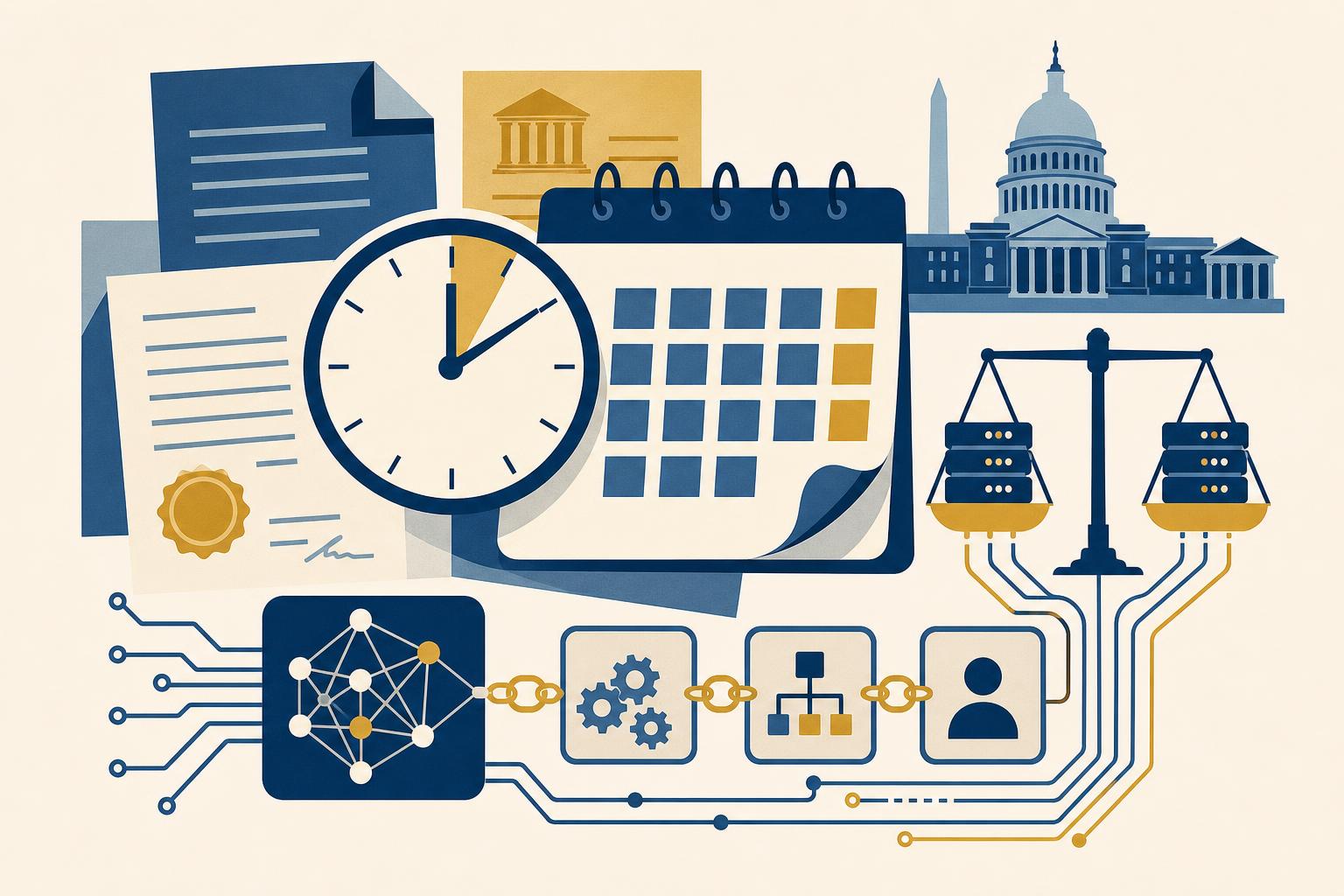
Illustration: AI Governance Enforcement Calendar — Bear Canyon Systems Daily Briefing | June 16, 2026


Comments